Students Helping Students: Physics Learning Assistants
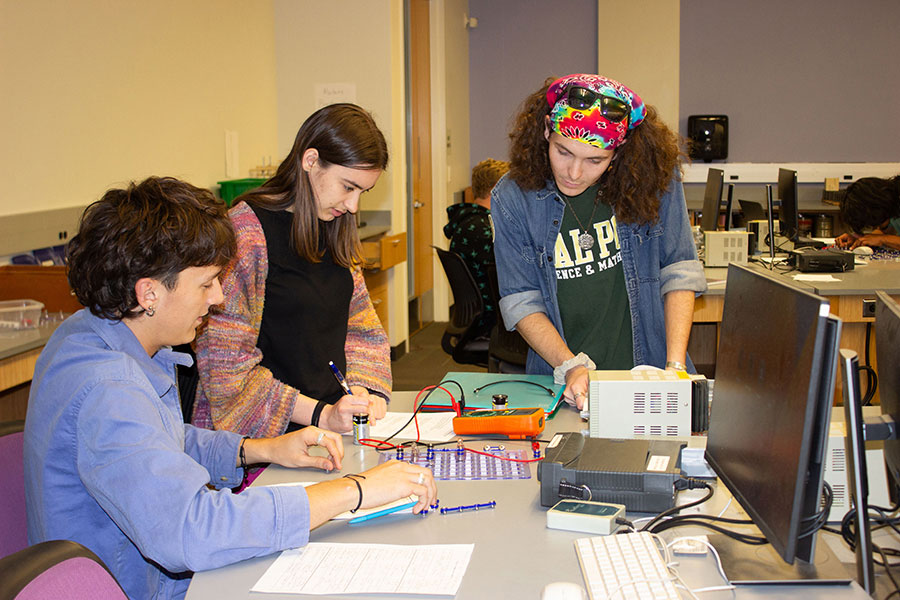 Zachary Yockey, a third-year Cal Poly physics student (right), is a department Learning Assistant. Here, Yockey helps students during a lab focused on a conceptual lesson on electrical currents. The course is taught by Physics Professor Stamatis Vokos. Photos by Nick Wilson.
December 2025 / NEWS STORY
by Nick Wilson
It’s Wednesday night, and students in Professor Stamatis Vokos’ General Physics lab are connecting wires on a circuit board as part of a conceptual lesson on electrical currents. Small groups of two to four students strategize, scan the whiteboard, and pore over their instructional handouts.
As brainstorming ensues, with some questions and confused looks, Vokos is assisted by two Physics Department Learning Assistants who circulate throughout the lab, providing support to students who may be stuck or simply want to float an idea.
Vokos' class is one of many classes that students find challenging. To support their learning in key courses, the Physics Department often employs Learning Assistants.
Learning Assistants (also known informally as LAs) are slightly more senior Cal Poly students who help students learn the material in the classroom for the first time by facilitating group discussions and critical thinking.
Learning Assistants are hired through a job application process and compensated through department funding, partially supported by donor contributions. Program support has included a recent, generous lead gift by Physics Department Professor Emeritus Randy Knight to help fund impactful learning opportunities in the classroom.
Overall, the Learning Assistant program trains students to help others achieve success through promotion of group discussion and interesting Socratic questioning. Inclusion of Learning Assistants has demonstrably improved student outcomes.
Learning Assistants must have taken the course to which they’re assigned and have earned a grade of at least a B or higher. They receive pedagogical training to serve effectively and review learning content before each day’s class begins. Each year, about 15 to 20 students serve as Physics Department Learning Assistants, working side by side with the instructor in a support role.
“I've grown to love it,” said Seann Brick, an aerospace engineering major who has served as a Physics Department Learning Assistant for over a year. “It's really nice to be in the classroom, providing an auxiliary role for all of the students, and to see how various professors teach and address the unique problems or circumstances of the students.”

Physics Learning Assistant Seann Brick (left)
helps students in lab.
Since 2017, Learning Assistants have helped all introductory physics students, including those who might otherwise struggle or fall behind. They facilitate learning in a wide variety of course instruction related to mechanics, electronics, instrumentation, magnetism, astronomy, geology, and more.
“I had Learning Assistants in three of my early physics classes, and they were phenomenally helpful,” said Zachary Yockey, a third-year Cal Poly physics student and current Learning Assistant. “Students will ask, ‘Am I doing this correctly?” Learning Assistants can put their mind at ease or help keep a student from digging a hole down the wrong path.”
Brick added: “One of my favorite parts of the job is walking around campus and seeing familiar faces, and having a student stop me and they'll say, ‘The only reason I passed that class was because you were there.’”
Whether a student is stalled on an assignment involving force, energy or acceleration, or simply needs a boost to spark conversation with classmates in group settings, Learning Assistants help students build their own models of learning by working through their reasoning.
“Learning Assistants ask questions such as ‘What are you thinking about?’ and ‘What does this remind you of from other classes or daily life?’” said Physics Professor Laura Ríos, the lead program coordinator. “From the moment we are born, we build up notions and patterns of how physics works. But there’s an inherent vulnerability in learning. Learning Assistant students learn how to properly support students in their Learn by Doing process through evidence-based learning.”
Ríos said that one of the learning curves in physics is to grasp the meaning of certain terms that are used in everyday language, but that have a different meaning in physics.
“If someone says, ‘I woke up with low energy’ or ‘This car has acceleration,’ that typically means something different than it does in physics,” Ríos said. “So, Learning Assistants have to try to get in the heads of students and understand what they’re thinking.”
Vokos, who established the Learning Assistant program in 2017 before Ríos took over in 2019, said it’s important to note that, while learning assistants guide students through data-driven learning practices, the job is not like a traditional teaching assistant: “There are profound differences. The role is not to teach or to explain, but to diagnose, and that's why pedagogical preparation is essential, along with content preparation.”
The way this works best is if the students in the class are working on group tasks, and productive questions from Learning Assistants help them put their heads together to solve problems. While designed to serve all students, the program has led to inspiring stories of struggling students overcoming challenges to pursue successful science careers.
Vokos recalls a former student who would pick grapes at night during harvest season to support his education. He’d come to class extremely tired and challenged by the material. Though he struggled initially, he found mentors and eventually turned his academic progress around. That student went on to become an effective Learning Assistant, then a graduate student, and later a high school physics teacher.
“His story is just awe-inspiring,” Vokos said. “It is so important to provide spaces for students to grow, so they don’t fall through the cracks, and to recognize that they have superpowers and just need the opportunity to grow and reach their full potential. The Learning Assistant program teaches emotional empathy as well as intellectual empathy.”
After graduation, Yockey said he’s thinking about pursuing a career in high school or college teaching, and the Learning Assistant program has helped him understand what it's like to be an instructor, as well as learn more about student fears and obstacles.
“The fear or humiliation of being incorrect can be very stressful,” Brick said. “Having somebody who you can relate to, someone who just took this class, look at you and tell you, ‘Yeah, I really struggled with that too and here’s what helped me.’ That’s amazingly beneficial to the learning process.’”
Vokos added that the Learning Assistant program can be excellent training for a variety of careers.
“If you intend in any part of your future to work with other people, this is wonderful preparation,” Vokos said. “You will have to anticipate the difficulties that are going to come up. You must be able to listen, gather ideas, and understand what is at stake for others to help the group make progress. Through their work, Learning Assistants become more sophisticated learners themselves.”
To help fund future Learning Assistant opportunities for students in the program, please consider a gift to the department here.
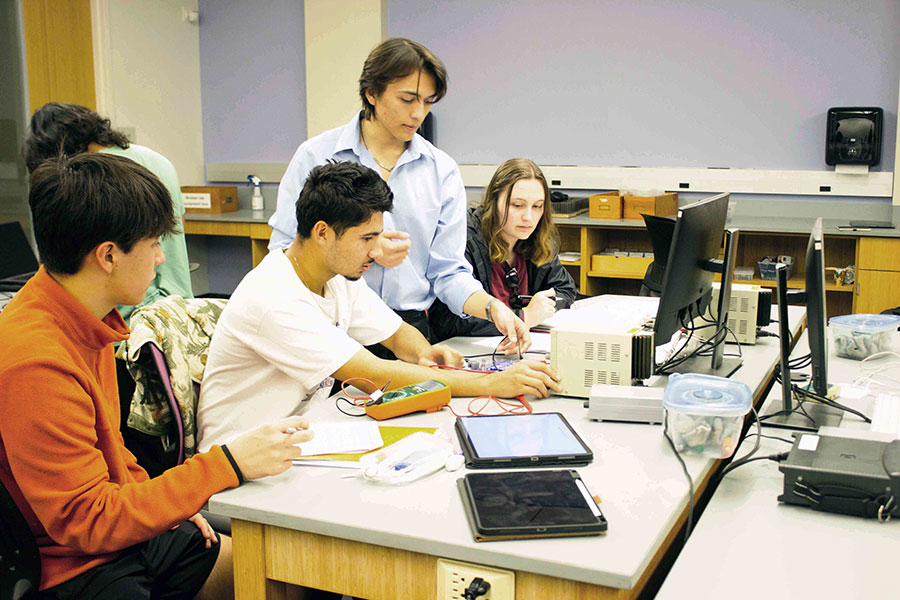 Physics Learning Assistant Seann Brick (blue shirt) assists students in a physics lab.