Student Mentorship and Empowerment: Biology’s ESTEEM Program
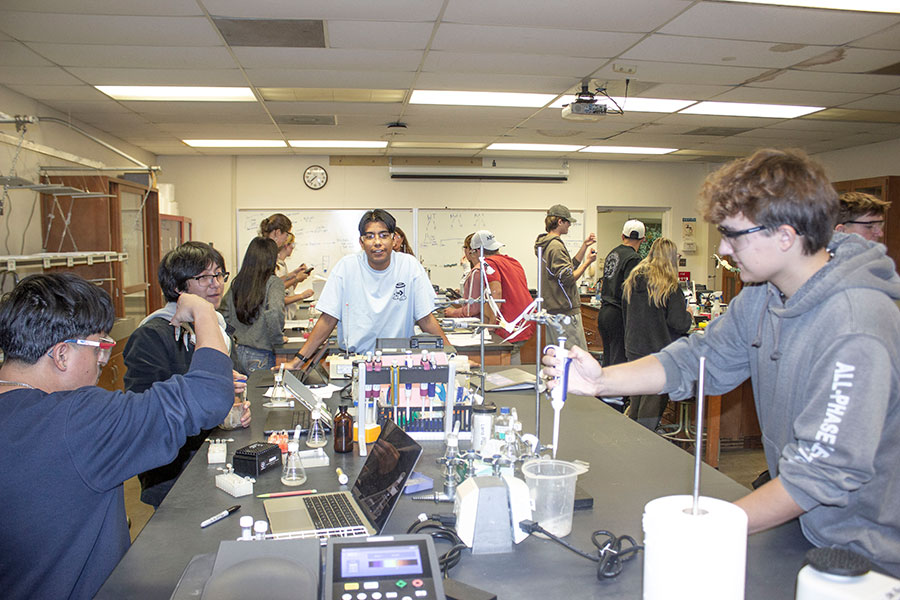 Biological sciences major Santos De La Trinidad (blue shirt) works with students in Biology 161 (Introduction to Cell and Molecular Biology) to offer guidance and support through the Empowering Scientists through Teaching Experiences and Exceptional Mentoring (ESTEEM) program. Photo by Nick Wilson.
January 2026 / NEWS STORY
by Nick Wilson
Santos De La Trinidad, a third-year biology major from the Central Valley community of Lindsay, is passionate about working in a lab.
Ari Evert, a third-year biology student on the pre-med track from San Jose, has overcome challenges adjusting to college-level rigor to become a better student.
Lucia Mendoza, a third-year microbiology student from Orange, is trying to decide between a career in academia and industry.
Each student in the Empowering Scientists through Teaching Experiences and Exceptional Mentoring (ESTEEM) program has a unique background and academic journey.
ESTEEM employs and empowers selected students to serve in support roles during classes and labs to help students in biology and microbiology coursework. Instructional student assistants (called ISAs) work alongside the lead faculty instructor to offer guidance and facilitate discussion.
ESTEEM student participants review course material, collaborate closely with the program’s faculty leaders and meet regularly with program peers outside of class.
The program not only offers students a part-time job related to their education, but it features a robust mentoring component that allow students to talk with faculty and fellow ISA peers about personal interests, ongoing Cal Poly research projects, career options and goals.
During a recent Thursday night lab in Biology 161 (Introduction to Cell and Molecular Biology), De La Trinidad buzzed around the room asking questions of student groups of three to get a sense of how well they were understanding the assignment and providing feedback. The lab led by instructor Monique DeMalteris involved adding the bacteria E. coli to try to break down lactose, the natural sugar in milk and other dairy foods.
“Getting a sense of how labs are set up and made to be engaging to students helps reinforce how much I enjoy working in a lab,” De La Trinidad said. “We set up labs with colorful solutions, work through problems together, and troubleshoot when an experiment doesn’t get the results we expected.”
Through the ESTEEM program, De La Trinidad’s knowledge of foundational science and how to teach it has grown dramatically, which has helped him become a better learner in his advanced biology classes, including in his studies of genetics.
“The principles of genetics are very fundamental to the work in upper division courses and perhaps one of the most important lessons students can take away,” De La Trinidad said. “Because I’ve reviewed this concept three times by now, it really reinforces my knowledge and makes me grateful to be an instructional assistant.”
The ESTEEM program, partially supported by donors with additional need for continued success, encourages participation from underrepresented students to join ESTEEM.
Program coordinators say the initial data has shown improved DFW rates, or the percentages of students receiving a D or F grade, or who withdraw, and it has helped close equity gaps.
Students enter Cal Poly with excellent grade point averages in high school, often over 4.0. But they may not be at the same level as their university peers, depending on their personal educational backgrounds, which might include whether they took Advanced Placement courses or had effective high school science instructors.
“Our intention is to really find standout students who come from demographic backgrounds that have been historically excluded from these opportunities, and to watch them grow,” said Sandi Clement, a biological sciences professor and program co-coordinator.
A future ISA student might not have achieved an A grade in an introductory biology course. But with faculty support and mentorship meetings, that same student can be highly effective in relating to and helping fellow students. ISA candidates are nominated to serve based on various factors regardless of their grade, including their willingness to help others in class, enthusiasm for the material and work ethic.
“ISAs typically come through from a recommendation by the lab instructor,” said biological sciences Professor Alejandra Yep, a department ESTEEM program coordinator. “Through learning and re-learning the material, ISAs gain a strong grasp of the concepts to explain them to others and become better students themselves. And that has a ripple effect. We hear often from other faculty that ISAs stand out in their other classes and become really engaged students.”
Lucia Mendoza serves as an ISA in biology and microbiology. She encourages students not to feel like they need to be perfect in a lab.
Microbiology student Lucia Mendoza (second from
right in top row) serves as an instructional
student assistant in ESTEEM.
“Often, labs and research are completely the opposite of perfect,” Mendoza said. “You have to be logical and learn how to troubleshoot. We had an experiment recently where none of the results in the lab groups came out the way they were supposed to. But that’s OK because you then go back and learn why that happened.”
Through ESTEEM, Mendoza has refined her knowledge, developed instructional experience, and learned about ongoing research opportunities from Yep and Clement. She still is considering her career options, which include teaching or industry job roles. And the program has helped provide exposure to options.
BIO 161 experiments have included extractions of DNA from bugs to determine a specific species, learning about genetic traits passed down from parents to second-generation flies and crossbreeding plants with different phenotypes (characteristics like green stems versus yellow stems) to observe outcomes.
“Working on the fly genetics experiments is probably my favorite of them all,” Mendoza said. “To figure out which genetic traits are passed down by parents to offspring is challenging, but super-rewarding. You have to use your knowledge of the subject matter and statistics to figure it out.”
Another biology ISA, Arianah (Ari) Evert, encountered her own challenges as a first-year student learning about cell structures, genetics, metabolism and lab techniques in BIO 161. Evert received a C grade in the class. But it wasn’t for lack of trying or interest.
At the time, however, Evert found it difficult to concentrate on the lecture and textbook information and was diagnosed with Attention Deficit/Hyperactivity Disorder (ADHD). She has since received treatment, and it has made a big difference in her success as a student.
To her surprise, the following quarter after taking BIO 161, Evert was nominated by biology professor Mallary Greenlee-Wacker to serve as an instructional student assistant.
“I genuinely never would have guessed that I was going to get recruited,” Evert said. “I was thrilled to find out about how the program works. I can empathize with students because I struggled so much.”
An aspiring physician, Evert loves her job helping others learn about biology and students often are willing to ask her questions or share frustrations in a way they might not with their lead faculty instructor.
“A big part of their success is being transparent about the challenging aspects of the course, emphasizing with them and supporting them,” Evert said. “It brings me so much joy when I see students from the class on campus or around town and they say, ‘You helped me so much.’”
Clement said the effect of the program is broad with “lots of beneficiaries from this work, but we need the financial support to continue to foster ESTEEM’s success.”
To make a donation to the Biology Department fund, click here.
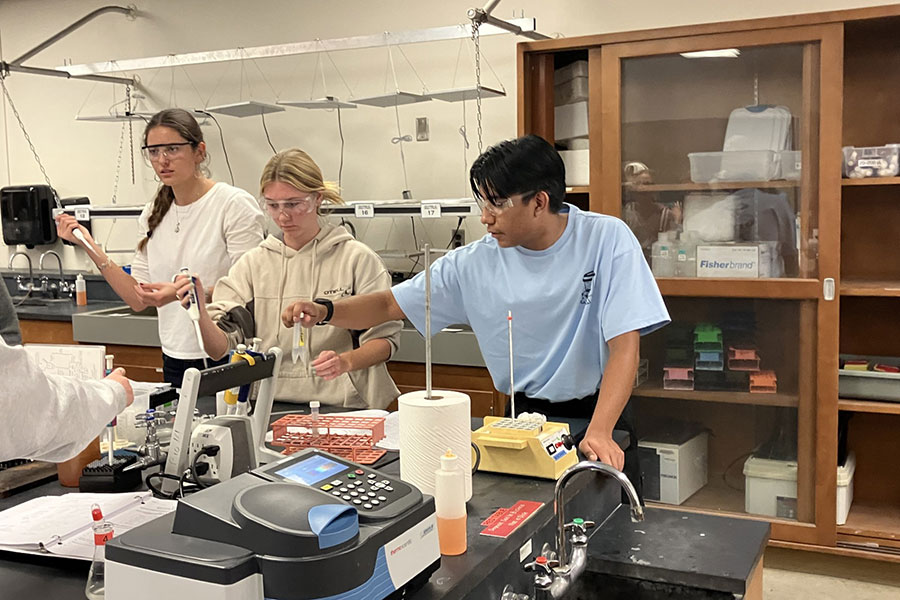 Santos De La Trinidad (blue shirt) assists students during a lab experiment in Biology 161.