Cal Poly Alum Shares Insights into Solar Energy Work in Africa
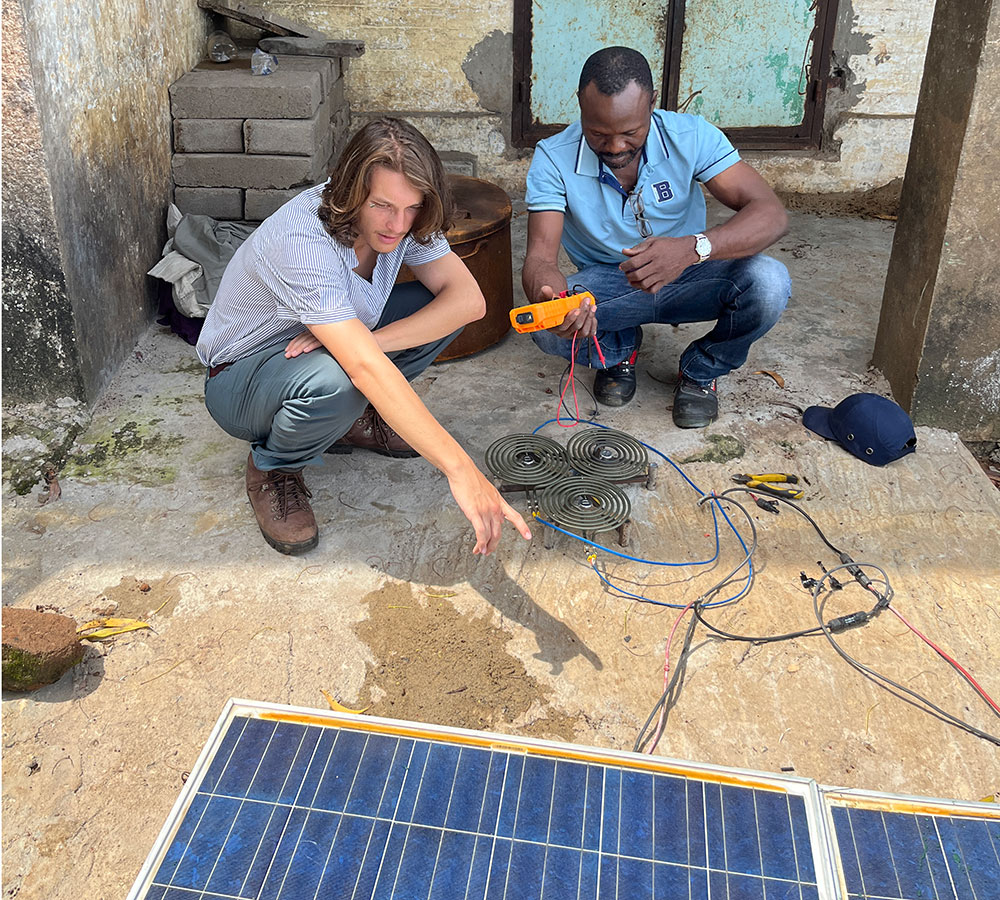 Ryan Marienthal works with Emmanuel, an engineer in Sierra Leone, on solar panels.
March 2026 / NEWS STORY
by Nick Wilson
Ryan Marienthal (Electrical Engineering, `25) has been deeply committed to help people in Africa by installing renewable energy systems, work inspired by his former teacher, Cal Poly Physics Professor Pete Schwartz, who’s currently in Malawi, Africa on a Fulbright Fellowship (follow Schwartz on his blog).
Marienthal, of Berkeley, California, a Bay Area community in Alameda County, spent four months on the continent in the fall helping to develop technology in coordination with Africans, and recently spoke about his experience serving people in the countries of Uganda, Tanzania, Sierra Leone and Malawi (also see his blog here).
Q: How did you get inspired to do this work?
A: I took Pete Schwartz’s Physics 310 course (Physics of Energy), and that's what got me on this path immediately. I didn't really know what I wanted to do for most of college. I thought I wanted to do something in music. I joined electrical engineering to make guitar amps. And then I had a crisis of faith with that. I started learning about power systems through that class and things like energy transfer, global warming and environmental issues, and then learned about all of Pete's research with solar technologies, and that just seemed like a perfect fit for me. Solar energy is by far the cheapest option, and it's more reliable.
Q: What led you to work in Africa?
A: I asked Pete at the end of the year ‘What should I do with my life?’ And he said, ‘Well, if it were up to me, you'd spend the next year of your life in Africa.’ I thought the idea sounded crazy at the time. But I ended up doing summer research with Pete on a direct current (DC) solar circuit that he was designing and ended up working really hard. We got along well; he introduced me to a couple of other people who had projects in Africa, and Pete recommended me because I'd worked so hard for him. I didn't have a plan beyond this. I then ended up going to Africa for four months between October and January.
Q: What were you researching with Pete?
A: So, it's directly related to solar power. What we're working on consists of me, Pete, and a man named Alexis Zeigler, who runs Living Energy Farm in Virginia, a zero-fossil fuel farm, and he's developed what’s called Direct Drive Solar or Direct DC Solar. The idea is to basically just plug solar panels directly into things without charge controllers, batteries, and inverters. This is very rarely done, but it saves cost and possible failure points in the infrastructure. With solar cookers and DC motors, you can just plug solar panels directly into them, and they'll work whenever the sun is out.
Alexis has been running a completely off-grid community of about 10 people, four acres of farmland, using about 90% solar energy cooking, and the other 10% is biogas (a renewable energy made of organic matter like manure, sewage and food waste). And so, our device keeps the voltage high, which greatly increases efficiency. Alexis is not related to Cal Poly, but he has partnered with Pete on various projects. I've been at Living Energy Farms twice now while developing the circuit. The first time was over the summer during the research.
Q: And you brought this technology to Africa?
A: I built a couple of those circuits in Africa and showed them to people and tested them there. And so, I continued the research I started over the summer in Africa in the fall because I found it really interesting. I got it working through my innovations in Africa, and then installed it when I came back to the U.S., at Living Energy Farm in Virginia as well.
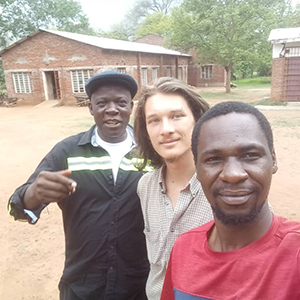
Ryan Marienthal with Victor (solar electric
and ISEC teacher) and Joseph (Kindle Orphan
Outreach director).
Q: How powerful is a DDS system?
A: It won't necessarily work to light a house. You still want batteries for that, because you need energy at night, but DDS works during the day when people need it for industrial work. That's when you do all your cooking and your machine work.
Q: How was it applied in Africa?
A: We were able to use a DDS system at a school in Uganda to help provide heat for institutional cooking. There are large 250-liter boilers installed by the British during the colonial period in the 1950s. They left behind six of these huge 250-liter boilers, which they used to run on three-phase power, but I think the hookup broke, or it got too expensive. So now they just cook with wood or charcoal, and it's the dominant cooking fuel in most of Africa. Electric cooking is quite rare.
We were able to plug some solar panels into the boilers that had already been provided by Jeremy Hayes, a Cal Poly engineering alum who worked with the school. Now the boilers just run for free, whenever the sun is out. We want to expand that program, and we actually have a collaborator now at one of the universities in Fort Portal, Uganda, where I visited as well, who's managing that project.
Q: What else were you working on?
A: Then the second project was in Sierra Leone. And so that was for another non-governmental organization (NGO) called Project Peanut Butter. We were working on installing this DDS at a factory they have there. They make this peanut butter food supplement called ready-to-use therapeutic food (RUTF), and basically it stops malnutrition in children with calorie-dense, effective, shelf-stable food. They were running a 60-kilowatt diesel generator, which is generally bad for the environment; it smells bad, and it costs a ton of money and fuel. And so, if they were to run on solar, it would be great.
So, they didn't convert to our design, but I just got word that they have everything running on solar panels now. So, through the work I was able to do there, even though they didn't follow our exact design, I was still able to provide all the data and energy measurements to give them a reasonable estimate of what they needed. I got all the information they needed to do a traditional solar installation.
A: And the third project?
Q: Pete connected with a primary school in Malawi, where I worked with an electrician who’s also a vocational teacher. He teaches about solar electric power and Insulated Solar Electric Cookers (ISEC), making solar cookers and doing solar installations. We worked with him to install classroom lights. They don't need lights during the day. It’s just sunny enough. But then we learned that students are sleeping there all night and studying late into the night for their exams. And so right now we're installing security doors, so the batteries that store power don't get stolen. I'm going back to Africa in the next couple months to finish that project.
Q: How are these projects funded?
A: Through various individuals, organizations, grants and networks. Because I’m working on different projects, there are different sources. Like the school project in Malawi involves working with a local nonprofit called Kindle Orphan Outreach. And they built a primary school, and we're installing lights and some basic solar electricity there for them.
Q: How well did you communicate in Africa?
A: People generally speak decent English, but I’ve noticed you just have to be very clear and very succinct. We're not used to this in America. We're used to dancing around issues, asking a lot of questions, so as not to offend people or asking a lot of questions at one time. It doesn't translate well. Instead of just asking “So, is your classroom too dark for you?” or “How is it on cloudy days?” just ask “Do you need lights in your classroom?” and then you’ll have your answer.
Q: What kind of associations did you make with people?
A: I made good connections with people, and we worked together, and we liked each other. They were more generous, and maybe more social than Americans, because we're just so closed off a lot of the time.
At the same time, I do represent the West. A lot of people jokingly or non-jokingly will say, “Oh, you're going to bring me to California, right?” A lot of people, you know, will just come up to you randomly on the street and follow you for a couple of blocks and say “Hey, man, I want to be your friend. I want to chat. Let me get down your WhatsApp.” They generally want money, things like that. That's very uncomfortable in a lot of ways because implicitly, they want to use you for money or opportunity or something.
There are a lot of nuances in the connections you make. And there are plenty of people who are my buddies and it was just good. And there's also people who are friends because they want something that's also just fine. You know, that happens all the time anywhere.
A: What’s your goal as an engineer?
Q: I wanted to make things that are useful for people. I think the most compelling part of this work for me is that I see its value. I enjoy that this helps people. I think that's what every engineer should be doing.
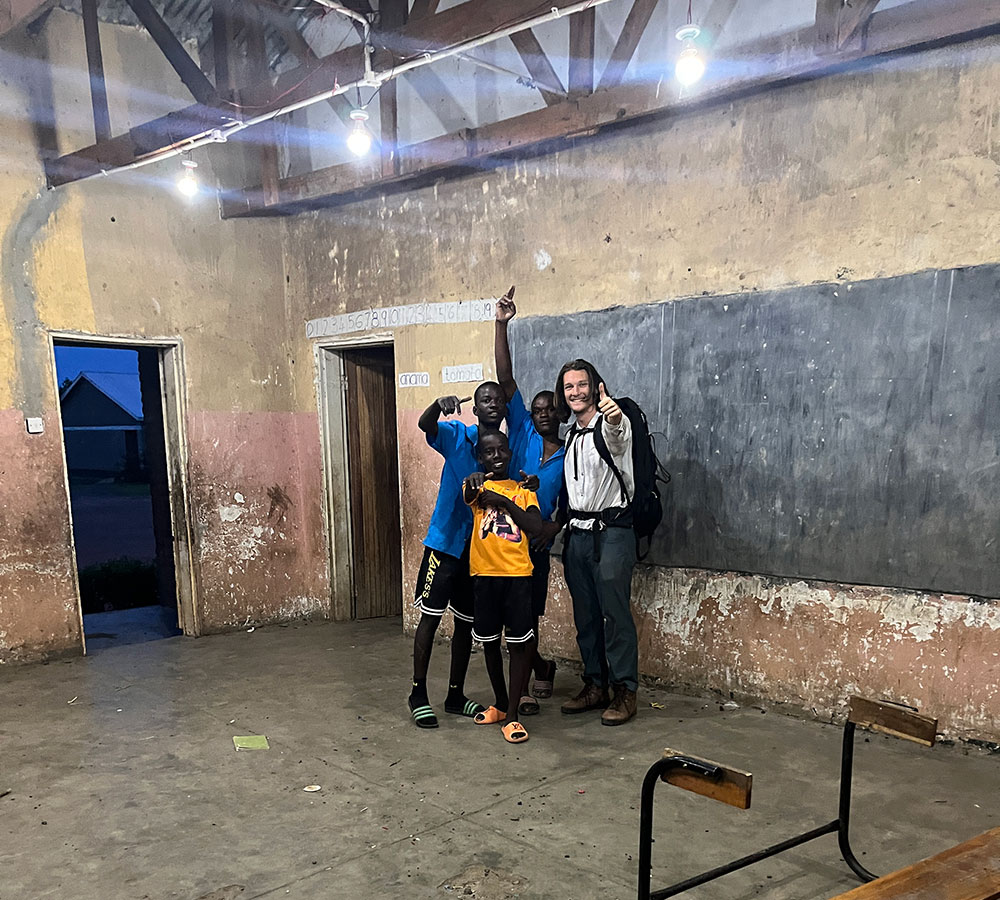 Ryan Marienthal with children in the school run by Kindle Orphan Outreach in Malawi, where they were installing lights.