Scientific Diving Course Inspires Career Beneath the Surface
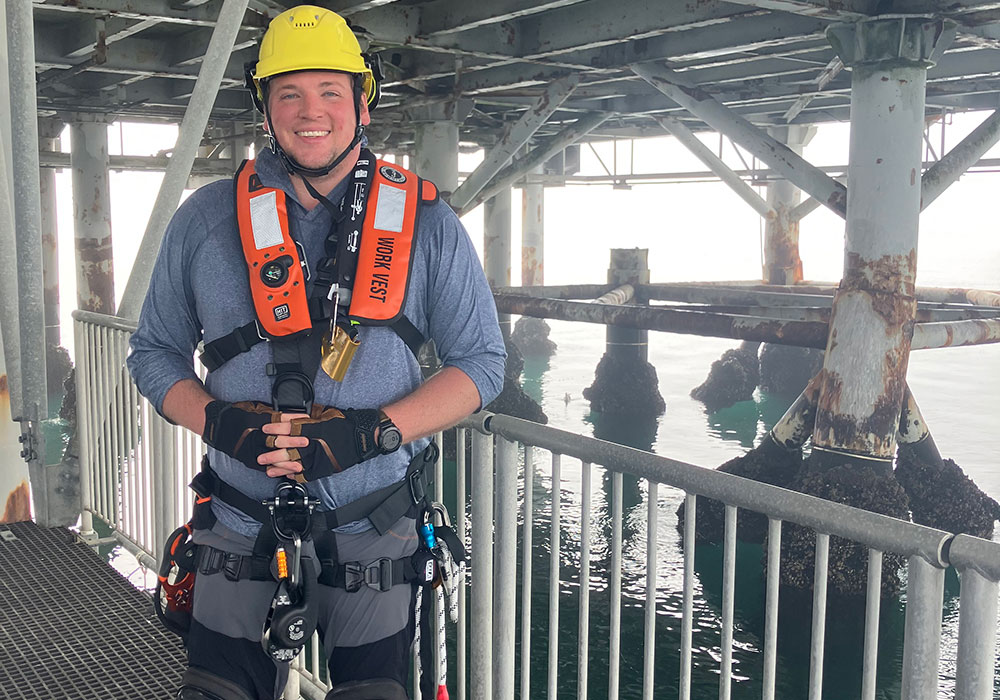 Connor Healy (Biological Sciences, `15) recently returned to the Cal Poly Pier, where he trained as one of Cal Poly's first Scientific Diving students, to help install tide datum instrumentation as part of a NOAA project.
April 2026 / NEWS STORY
by Nick Wilson
Connor Healy (Biological Sciences, ’15) was among the initial cohort of students who took Cal Poly’s inaugural Scientific Diving course in 2014 taught by Jason Felton, the university’s diving and boating safety officer, and Kaitlin Johnson (M.S., Biological Sciences, `16).
The experience helped shape Healy’s future underwater career.
Healy, 32, is now an operations officer for the Dive Center of the National Oceanic and Atmospheric Administration (NOAA), where he leads diver training courses and travels to marine and freshwater locations across the United States to support various projects.
Based at NOAA’s Western Region Center in Seattle, Healy fondly recalls his Cal Poly experience learning under Johnson (who remains a co-instructor of Scientific Diving while serving as a senior scientist at Tenera Environmental Services) and Felton, with whom he reconnected in San Luis Obispo County while on the job in mid-April.
“My learning experience at Cal Poly, training with Jason and Kaitlin, is still one of my greatest experiences in diving education,” Healy said. “At the time, Cal Poly was just building the marine science program (a marine sciences bachelor’s degree was formally established in 2016). It all worked seamlessly and the instructors put us through a very well-designed and rigorous Scientific Diving course.”
Over the course of a few days this spring, Healy donned diving gear and entered the ocean waters of Port San Luis as part of a team that helped install tidal datum instrumentation at the Cal Poly Pier. The project involved relocating an existing monitoring system from the Hartford Pier as part of a partnership between the university and NOAA.
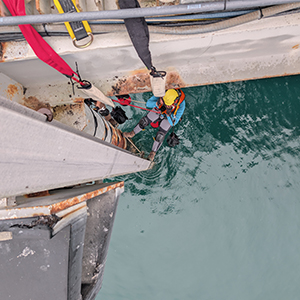
Connor Healy installs equipment at the Cal Poly Pier.
The technology is part of an integrated system of sensors operated by NOAA’s Center for Operational Oceanographic Products and Services (CO-OPS), which is deployed in seaports across the U.S. to provide accurate, real-time environmental data.
Data on tides, sea level, and meteorological conditions (including air temperature and wind) are collected through these systems and used by commercial fishermen, mariners, surfers, oceanographers, divers, coastal engineers and others.
“This project was conducted through CO-OPS, and they do a lot of coastal monitoring,” Healy said. “They have stations throughout the U.S., American Samoa, Guam and many other locations. We supported their dive and climbing operations to help build and maintain these monitoring stations.”
Healy said his Cal Poly instruction allowed him and fellow students to immediately work with principal investigators to collect marine data and samples.
Since graduating 11 years ago, Healy has also worked with the U.S. Fish and Wildlife Service, conducting freshwater diving, and with Channel Islands National Park as a scientific diver. With NOAA, he has been stationed in Ketchikan, Alaska, working aboard a research vessel, and now in Seattle at the NOAA Diving Program center, where he trains future divers and supports various operations, including deep-water explorations.
Since that first scientific diving course 12 years ago — an expansion of a program established at Cal Poly in 2009 — Felton said the training has continued to thrive, preparing students to dive safely and effectively under professional standards.
“We’re trying to make students such good divers that scuba diving becomes second nature,” Felton said. “That way, they can focus on the task at hand, whether that’s installing oceanographic equipment, conducting subtidal surveys, or collecting organisms for lab study.”
Training includes extensive classroom work in diving physiology, physics and decompression theory, along with hands-on practice in the pool and ocean.
“We spend a lot of time doing advanced drills so that everybody is very comfortable with their equipment,” Felton said. “It’s not just about being comfortable when everything is going right but being prepared to handle challenges as they arise.”
Healy said his Learn by Doing experience was a formative influence on his career.
“My career is very much based on my time at Cal Poly — not only the excellent education I received, but also discovering my interests,” Healy said. “Cal Poly does a great job of giving students the opportunity to explore different paths and find what they want to pursue.”
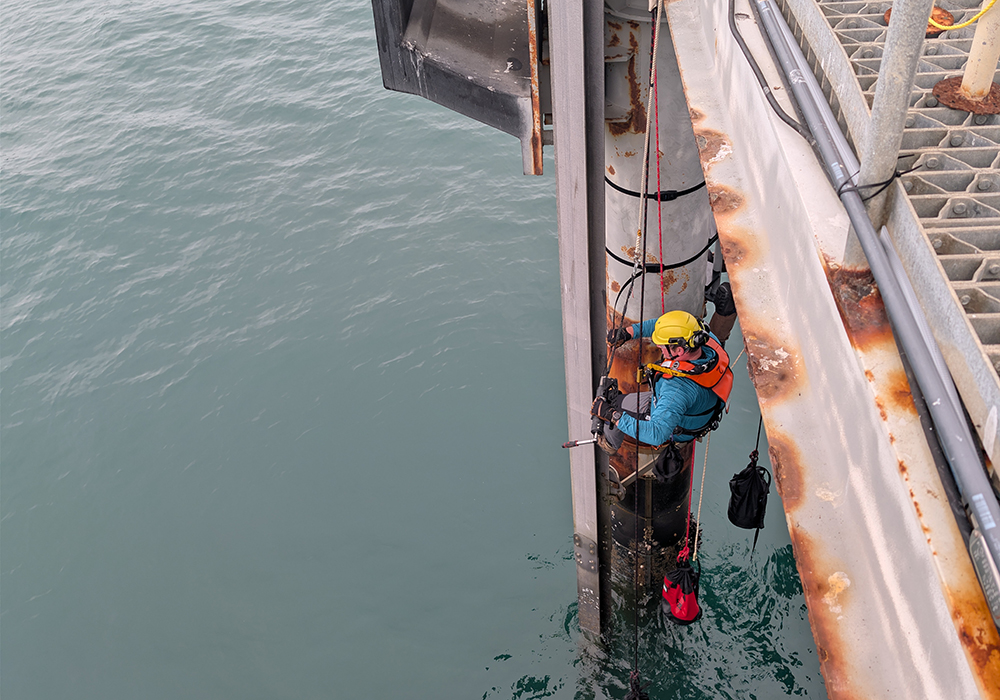 Connor Healy travels to marine and freshwater locations across the United States to support various projects, like installing environmental monitoring equipment the Cal Poly Pier (shown here).