Field Quarter Features Learn by Doing in Nature
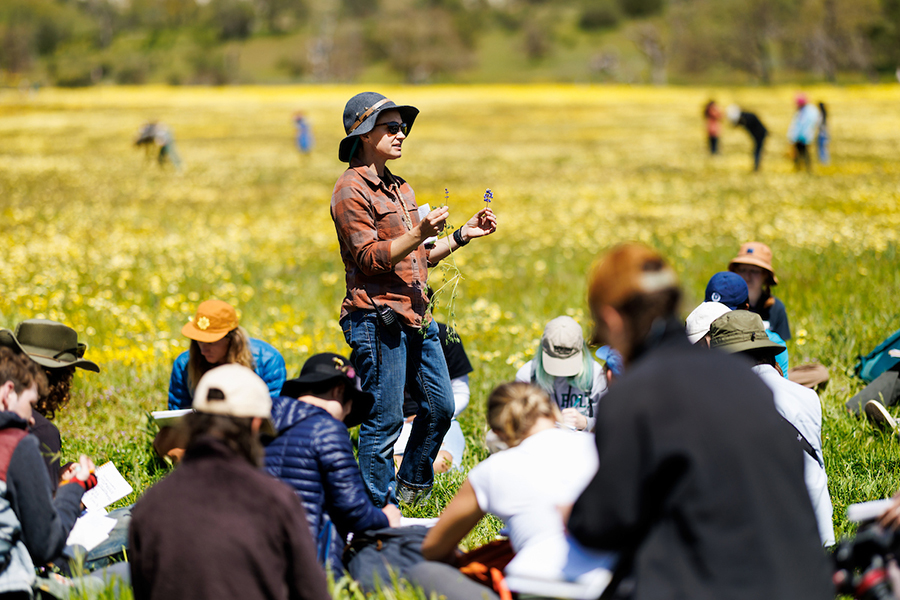 Biological Sciences Department Professor Jenn Yost (middle, standing) during a botany field excursion in the Carrizo Plain in 2023. Yost is one of the four biology professors leading Field Quarter in Spring 2026. Photos by Joe Johnston.
February 2026 / NEWS STORY
by Nick Wilson
Offering an extraordinary Learn by Doing experience in the last academic quarter ever to be held at Cal Poly, 35 students will travel throughout California this spring to study the state’s rich biodiversity.
For decades, Cal Poly biology teachers have taken students into the field as part of labs and coursework to observe plants, animals, and ecosystems.
For the first time, however, four distinguished biological sciences faculty members are teaming up to teach “Field Quarter,” dedicating the entire quarter to observing nature in remote settings. This experience will combine the much-loved courses of Field Botany, Herpetology, and Ornithology.
Drs. Jenn Yost, Matt Ritter, Emily Taylor, and Clint Francis, an all-star lineup of experts in their fields, will teach and observe nature together, taking in California’s rich biodiversity of plants, trees, reptiles and amphibians, and birds.
“Ever since I came to Cal Poly, we’ve talked about an in-depth biological experience that would take us to amazing places and cover all aspects of biology, from ecology to examinations of specific organisms and more,” Yost said. “Because we are now converting to semesters (this coming fall), this would be the last time to make it work for all of us in the quarter system.”
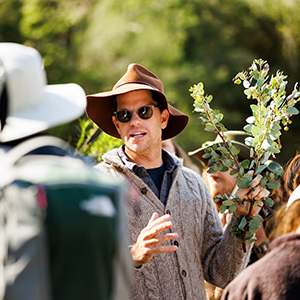
Biological Sciences Department Professor
Matt Ritter.
Excursions throughout the 10-week quarter will span the Mojave and Sonoran deserts, the redwood forests of the North Coast, the volcanic landscapes around Mount Lassen, the Central Valley’s migratory bird wetlands, and the mountain passes of the Sierra Nevada — a true immersion in the Golden State’s living diversity.
The professors began recruiting students for enrollment a year in advance to allow time in their class schedules to dedicate to the coursework.
“Being observant is one of the greatest skills in the world,” said Erin Virnig, a fourth-year biological sciences student from Arroyo Grande, who’s enrolled in Field Quarter. “It’s so life-enhancing for me, and I know these skills are what I’m hoping to carry throughout my personal and professional life. It’s important to recognize that so many professionals and students at other schools want these kinds of field-training opportunities. I’m so grateful to be part of this comprehensive study of the plants, the herps, the birds, and all of that diversity in California, all at once.”
To cover trip expenses and support student participation, fundraising efforts have raised more than $30,000. Anyone who wishes to help support the program can click here and designate “Field Quarter” in the special request box along with a donation.
While field experiences are already incorporated into Cal Poly Biological Sciences Department classes on a more limited basis, Field Quarter will be a full-time enrollment commitment for students.
“All the different things that had to come together to allow four faculty members to dedicate all their time to a class like this is a very special event at any university, and it represents Cal Poly’s commitment to offering students this exceptional educational experience,” Ritter said.
The group of faculty and students will travel together on trips that will entail lodging in field stations and camping while learning about and observing the natural world.
“In the field, you’re hot, you’re cold, you’re uncomfortable; it may snow, and your car may get stuck,” Yost said. “There are just so many real-life things that we experience that you can’t make that stuff up. And so everybody bonds around it, and we have a shared experience.”
Yost said that field biology experiences can yield unexpected events, which become a treat and a learning experience for students, expanding their knowledge beyond textbook information.
“One year in Joshua Tree National Park, in the Field Botany class, we spotted a Calochortus kennedyi,” Yost said. “This plant looks like a California poppy, except it’s much tougher, has bright purple anthers on the inside and hairs on the outside, and has these beautiful blue leaves and stem. It’s stunning. And it’s so rare to see it. I saw it only that one year. I go to the same spot every year, and the rain was just right that year to see that plant.” The joy of finding new things rubs off on the students.
The field observation experience honors the work of Drs. Dave Keil and V.L. Holland, former Cal Poly biological sciences professors who led field botany excursions for decades. Keil and Holland worked as a team, teaching field botany starting in the late 1970s. Each spring quarter, the pair took their field botany class on multiple field trips, ranging from day trips to Morro Bay to a four-day trip in the desert, culminating in a snowball fight in the Sierra Nevada mountains.
“Back in those days, Cal Poly owned a bus that would drive them to all these places,” Yost said. “They have so many stories of the bus breaking down on the side of the road, and then they would just go botanizing while they were waiting for a tow truck or a mechanic to come fix the bus. Dave and V.L. really laid a legacy of field botany, and the class is transformative for everybody who takes it.”
A renowned expert on snakes, lizards and amphibians, Taylor said that some of the Field Quarter excursions will take place locally along the Central Coast, with the furthest reaching the Southern Oregon area.
“We’ll be talking about methods for finding various animals and plants,” Taylor said. “We’ll have a checklist of what could occur in the area, and we’ll talk to students about how they would look for species, from listening for amphibians to flipping rocks to look for reptiles underneath.”
Taylor said the students will study natural history and why certain species might be endangered and why some might thrive.
“Behind everything, there’s going to be this undercurrent of just learning the general biology,” Taylor said. “Cal Poly has a history of getting students interested and prepared for careers in science, whether it be state parks, the forest service or academia. This will inspire students to want to pursue those pathways.”
Already, the students have joined hikes at the Pismo Preserve and Montaña de Oro to get to know each other better and start observing ecology together. And some attended Taylor’s talk celebrating the release of her recently published field guidebook “California Amphibians and How to Find Them.”
Virnig said she specializes in botany in her studies, but she’s excited to learn more about amphibians and reptiles, which students will get to handle with proper guidance and to explore places in California she hasn’t visited yet.
“We’re going to get exposed to new areas that we can return to later in our lives and potentially in our careers, and we will become familiar with all those different communities and habitats throughout our state, north to south, west to east,” Virnig said.
Biological sciences major Grace Cadwalladerolsker looks forward to expanding her knowledge and visiting new areas.
“I’m excited to visit the redwoods,” Cadwalladerolsker said. “I went there once in high school and thought it was the most magical place I had ever seen. I’ve tended to focus on reptiles during my time at Cal Poly, so I’m excited to see their diversity across California. I enjoy sitting and watching animals behave. This is a great opportunity to practice field science and really see how plants, birds, and reptiles coexist.”
Hanna Waite, a fourth-year biological sciences student, added: “At heart, I’m a botanist. But I think this opportunity to learn about birds and herps will open a door to a deeper understanding, and maybe even a passion for them. I'm very open to becoming a well-rounded biologist.”
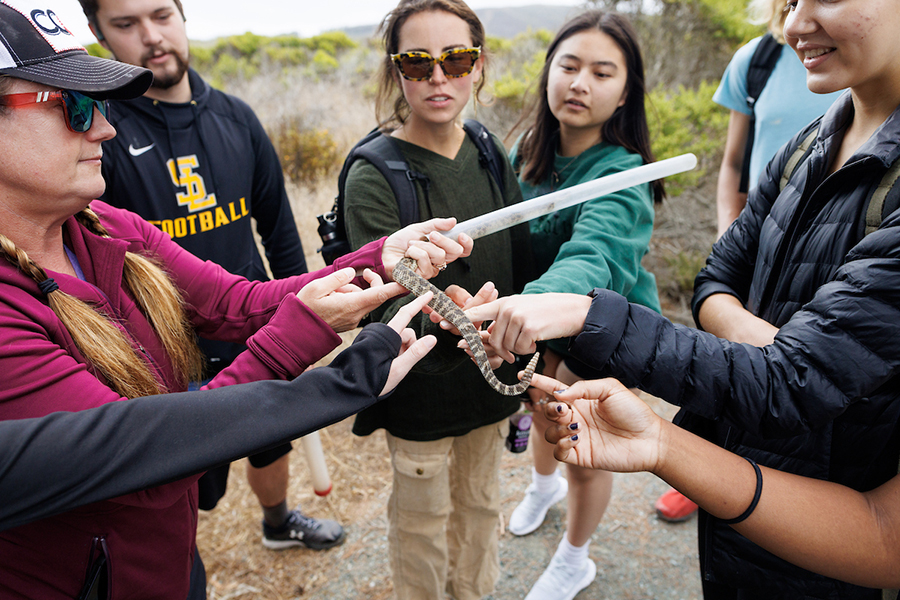 Biological Sciences Department Professor Emily Taylor (left) and students observe a rattlesnake during a field outing in 2022.