Learning Assistants Power Student Success in Cal Poly Chemistry
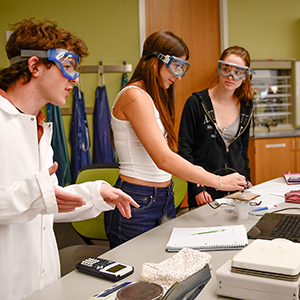
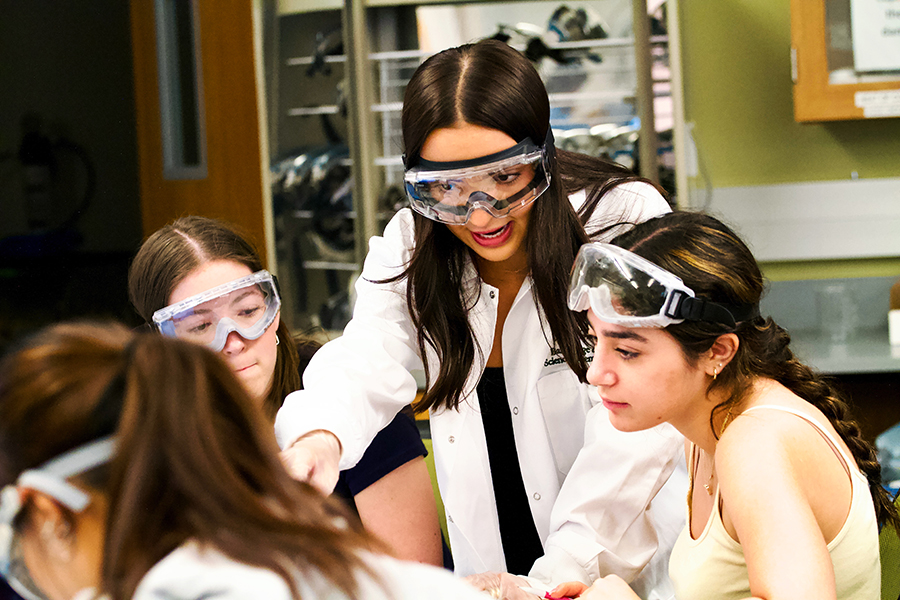 Biological sciences major Abigail Harvey, a learning assistant in chemistry and aspiring physician, helps students during a lab procedure. Photo by Amelia Tai.
January 2026 / NEWS STORY
by Nick Wilson
A common experiment in Cal Poly’s general chemistry instruction involves measuring the concentration of blue dye in a bottle of Gatorade.
While the sports drink is recognizable to the students, the learning concepts may be unfamiliar, including the instruments (spectrometers) used in chemical analysis to determine the dye concentration and the scientific law (Beer-Lambert) applied to solve the problem.
New to the material, students may quickly become lost, confused or simply want to raise questions, and that’s where learning assistants often come in.
Each quarter, about 55 upper-division Cal Poly students are employed through the Chemistry and Biochemistry Department’s Learning Assistant program, providing valuable support by helping the instructor during general chemistry course activities.
Learning assistants, commonly referred to as LAs, address student questions, engage in discussions, solve problems and provide support in studio classrooms (combining lectures and labs) with classes of up to 64 undergraduates from a wide variety of majors.
“Learning assistants are crucial to being able to help with everything in the classroom,” said Alan Kiste, a chemistry professor and department coordinator of the Learning Assistant Program. “We combine training in both content and pedagogy to help learning assistants develop teaching skills, as well as encourage them to bring their own experiences to support fellow students.”
The program serves about 1,800 students per quarter, with only about 10% of those being chemistry majors. In any given quarter, the program affects almost 10% of Cal Poly’s student body who enroll in general chemistry courses.
The program, partially funded by donors, has operated within the department for more than a decade. Student learning assistants offer notable benefits to all involved and continued donor funding is needed for future success.
During studio chemistry classes, students mix chemicals, work with fragile glassware, conduct simulations, work on problem sets, engage in discussions, use molecular modeling software and more. Learning assistants are not teachers or teaching assistants. Rather, they’re trained to lead students to develop their own understanding of the material through proper coaching.
Learning Assistant Sam Catania (left) and
students during a chemistry lab session.
Photo by Eileen Vavra.
“I’ve most enjoyed having the opportunity to work with students to help them understand concepts they’re really struggling with,” said Sam Catania, a learning assistant and fourth-year biochemistry major from Monterey, California. “The most educational part has been learning how to craft questions that effectively guide students to finding the right answer without directly telling it to them or confusing them more.”
Biological sciences major Abigail Harvey, a second-year student from Petaluma, said her chemistry learning assistant role has been valuable in developing her skills to explain, instruct and listen to students who face challenges as she pursues her goal to become a doctor.
“One example is when students get stuck on difficult concepts and don’t feel comfortable asking the professor right away,” Harvey said. “I’ve been able to step in, break the idea down into smaller steps, and explain it in a way that feels less overwhelming. Since I’ve been through the course myself, I understand where the common sticking points are and can offer explanations that match how students are thinking in the moment.”
Learning assistants are mentored by faculty members to deploy effective instructional methods, which in turn prepares them for careers in academia, industry and professional roles.
“Being a learning assistant has taught me how to communicate clearly and be patient when explaining complex ideas,” Harvey said. “These are the same skills doctors use when working with patients, answering questions, and helping people understand their health. It has also shown me how rewarding it is to support others, which reinforces my goal of going into medicine.”
Kiste said that students in Learning Assistant programs succeed at a higher rate, achieve better grades and persist in their classes and majors. The benefits have a positive effect for underrepresented and first-generation students, in particular.
“I tell the learning assistants that they have 100% more experience being a student in our classes than I do,” Kiste said. “If they had problems understanding a lesson, if there were conceptual stumbling blocks for them, that’s helpful experience for them to work with the students because it's likely the students have the exact same challenges.”
Chemistry is a challenging subject, and some students are more comfortable asking an LA for help than asking the instructor, Catania said.
“I think LAs are especially helpful during the lab activities because students sometimes follow instructions without fully understanding what they are doing, which can cause them to get stuck on the data analysis and post lab questions,” Catania said.
Absorbance spectroscopy (commonly used to identify substances and determine concentration) is a learning concept students that often struggle with, according to Catania, who added: “I’ve found the LAs are really helpful for guiding students to connect their results from the lab activity to solving more challenging conceptual problems
As a teaching assistant in graduate school, Kiste received minimal guidance and said that a Learning Assistant program would have better prepared him for that role.
“Just about every job our LAs might pursue later in life has a teaching component, whether that’s a leading weekly stand-up meeting or engaging in medical conversations with patients or speaking to pet owners seeking veterinary care for their animals,” Kiste said. “And some LA students become teachers, and this program offers them experience in an instructional setting to help others learn.”
Students overwhelmingly “love having LAs in their class, and the single most common reason that LA applicants give for why they want to be LAs is that they had such great LAs when they were students,” Kiste said.
Learning assistants can benefit by reinforcing general chemistry concepts that may help them succeed later, such as preparing for the MCAT, the medical school admission exam, as well as enhancing knowledge for upper-division coursework. The program provides opportunities to refine knowledge and grow.
“My long-term career goal is to be a biochemistry professor at a university, and this program was my first opportunity to develop teaching skills and assured me that this is a good career choice,” Catania said. “I just finished applying to Ph.D. programs where I’ll likely be a teacher’s assistant for general or organic chemistry, which this program has definitely prepared me for.”
Another chemistry learning assistant, Jasper Aikenhead-Cross, said “the part I most enjoy about the Learning Assistant program is the times when you really feel as if you are helping someone not just understand a problem but the foundational concepts beneath it.”
To support the Chemistry and Biochemistry Department’s Learning Assistance program, click here.
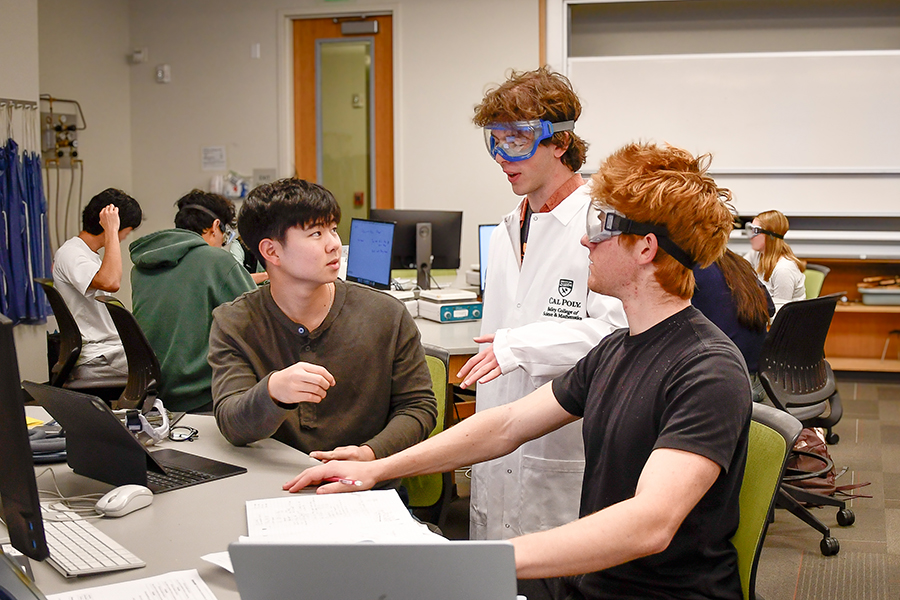 Sam Catania (second from right) guides students. Photo by Eileen Vavra.