

Q&A: Geology Professor Shares Insights into Career, Art, Quakes
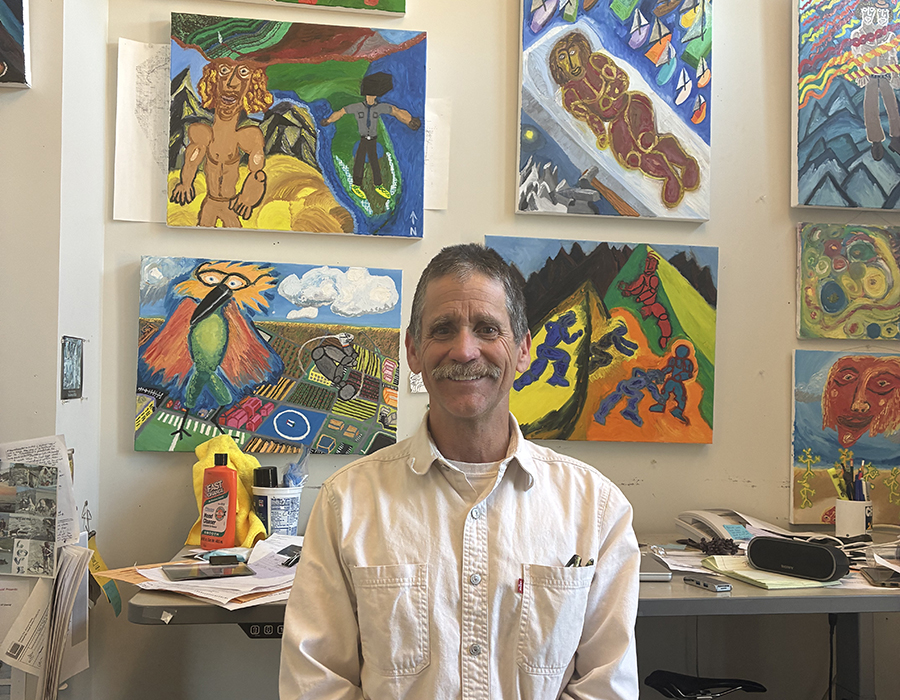 Physics Professor Tony Garcia, who specializes in geology, in his office with his art work in the background. Photo by Stella Goldstein.
February 2026 / NEWS STORY
by Stella Goldstein
Physics Professor Tony Garcia began teaching geology at Cal Poly in 2001. Over the past 25 years at the university, his career has included fieldwork and intensive study of geomorphology, examining why landscapes look the way they do. Garcia has taken student groups to mountain ranges throughout the Central Coast and to the San Andreas Fault in the Carrizo Plain.
Raised in Miami by Cuban immigrant parents, Garcia later used his Spanish language skills in Southern Spain while in graduate school, studying landscapes shaped by tectonics and climate.
In his spare time, he hikes with his hybrid wolf dog and two huskies, explores the rock formations and natural beauty of the Central Coast with his dogs by his side, rides motorcycles, and paints (including portraits of natural terrains). Garcia shared his thoughts on his studies, life experiences, and how his journey took shape.
Q: How would you describe your field of study?
Garcia: I’m a geomorphologist, specifically a fluvial geomorphologist. I study landscapes and mountains from the perspective of rivers. One thing that’s really handy about rivers is that when mountains are rising, you can use the rate at which the river is downcutting to estimate the rate at which the mountains are rising. Landscapes hold a ton of information about climate and climate change. It’s kind of a two-way street. You can either look at it as I’m studying landscapes to understand how the Earth has changed, or I’m studying landscapes on their own to see how they were affected by Earth’s change.
Q: How did you choose your career?
Garcia: It wasn’t a straight line. I started out wrestling in college and originally planned to study geology. I went to UCLA to study geology. Fortunately, UCLA had a better art program than a geology program. So, I had to choose between art and geology, and I was just so drawn to art. Later, while living in the Santa Cruz Mountains, I was commuting by motorcycle to the Bay Area to substitute teach when I flipped through a course catalog from San Jose State University and saw the word “geomorphology.” I read the description and thought, ‘You can actually study landscapes from a geological perspective? I want to do that.’ So I went, and I loved it.
Q: How did you get into painting?
Garcia: At UCLA, I was surrounded by artists. I was just painting as much as I could. Then I got into performance art. For example, I built a big catapult. I made it all. I welded the structure together. It would fire paint balloons up into the air, and my colleague would catch them on a canvas. It was physical and expressive, not unlike wrestling. I fell in love with it. Eventually, I was working and stopped making art for a while, but I always had a living and breathing sketchbook. At Cal Poly, a colleague made a CD, and I thought, ‘If he can do that, I can start painting again.’ So I did. But oil paint in a small house doesn’t work. Paint drips everywhere. So I switched to ink, and I just kept doing it. That’s what I’m going to do when I retire.
Q: Who are some of your art influences?
Garcia: Paul McCarthy. He was really into exploring societal taboos, like, for example, representing giving birth through his head (in one of his performance art pieces). I took a lot of his classes at UCLA. It was all performance art. And Joseph Beuys. He was a fighter pilot in World War II and he was shot down over Siberia and saved by Indigenous people, whom he lived with for months. To save him, they wrapped him in felt and lard because he was frozen. So, then the war ends, all that happens, and he comes back to society, and he was very much influenced by these tribal cultures. The framework he proposed and advocated is to be in touch with things that are spiritual. When he finally came to the U.S. to show his art, he had himself wrapped in felt and captured a coyote from the wild. Beuys put himself and the coyote in an art gallery with a stack of New York Times newspapers, and then he had this cane and this blanket, and he spent like two days in this room with the coyote and just interacted with it like that. That really made a big impression on me. He was able to be in touch with things like that and most of society isn’t. To me, that’s where I make the connection between art and science. It serves a purpose, but it’s also something bigger that we need to be in touch with.
Q: Can scientists predict the next big earthquake?
Garcia: By definition, there’s no way. There’s no formula. We have predictive modeling over long periods. They can give a rough ballpark figure, say, in the next 30 years. But we can’t predict the exact time. There was a series of earthquakes in Parkfield, California, that’s super telling of this. Throughout the 20th century, they regularly had fairly large earthquakes every four or five years. Then they had a big earthquake, and the geologists said, ‘All right, we're going to take advantage of this.’ It had been regular for decades, I'm not kidding. It was always at the same time, these earthquakes. So they said, ‘We're going to put in all these instruments, and we'll see exactly what to look for in the future when there's an earthquake.’ They're still waiting. It's been about 50 years, and it just didn't happen again.
Q: What’s it like taking your dog out with you on field excursions?
Garcia: I had a wolfdog, her name was Mica and she was amazing. Mica’s time has come and gone. She was a soulmate in the deepest way possible. For field work now I only take my Siberian Husky, whose name is Rokki. Rokki and I may not have the telepathic relationship like I had with Mica, but Rokki is loyal beyond belief and she takes care of me. She's a great geology companion. I do field work with her, and it's awesome. She can't be off leash because she'll just chase deer. The prey drive of the Huskies is crazy. Huskies are obsessive, and that can be directed at deer. So around here, she can’t be off leash. She'll just take off. But in the desert, jack rabbits are all there is to hunt. Jack rabbits don't go very far, so that's fine because, consequently, my dog doesn't go very far when she chases them.